Polynucleotides, Skin Boosters, Exosomes or PRP: Which Regenerative Treatment Suits Whom?

As of: October 2026
The short answer: All four treatments improve the quality of your skin instead of adding volume. They differ in what they use to stimulate the skin: skin boosters with hyaluronic acid, amino acids and nutrients, polynucleotides with DNA building blocks, PRP with growth factors from your own blood and exosomes with cell signals. Which treatment is right for you is decided not by trends, but by your skin, your goal and the season.
Key points at a glance
- Skin boosters (Jalupro® SuperHydro, NCTF®) are the entry point: hydration, freshness and glow, often visible after the first session.
- Polynucleotides (PhilArt®) are the choice when the skin looks thinner and more tired and regeneration matters more than hydration. Only during the low-sun season.
- PRP works with your own blood and at our clinic is performed by a physician at Perfect Skin MED. For anyone who does not want any foreign substance.
- Exosomes are the newest approach. We do not inject them; instead, we apply them to the skin after microneedling. They complement other treatments.
- We offer all four treatments under one roof. That is why our advice is not biased toward any one method.
Polynucleotides or skin boosters, exosomes or PRP: anyone looking for skin rejuvenation without fillers today quickly comes across these four terms. All four belong to regenerative aesthetics, and we offer all four here in Berlin. Over 26 years and more than 220,000 treatments, we have seen which skin responds to which stimulus. This guide puts the four treatments into context so you can come to your consultation with a clear idea.
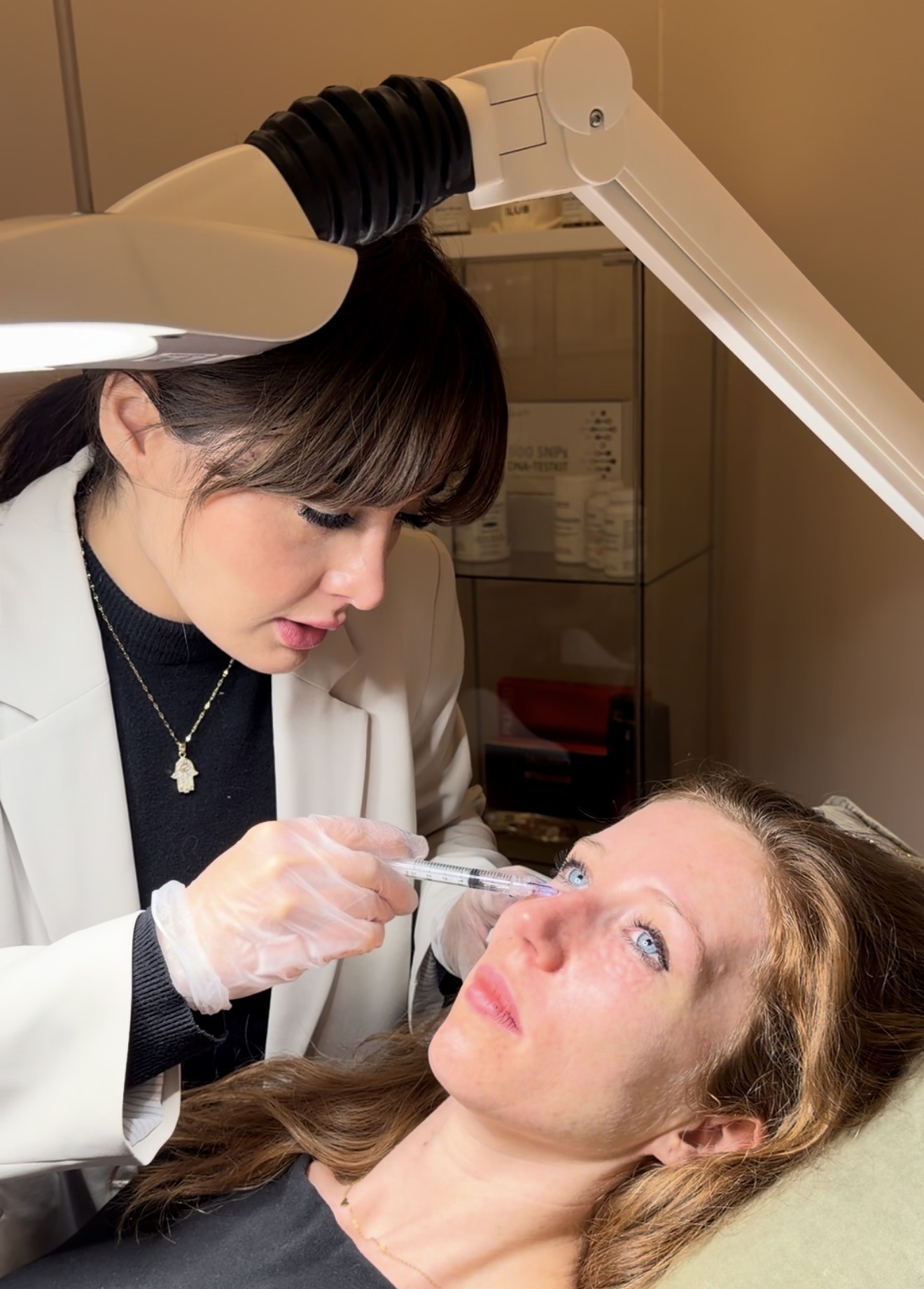
What Is the Difference Between Polynucleotides, Skin Boosters, Exosomes and PRP?
None of the four treatments fills anything. They stimulate the skin to produce more collagen, elastin and moisture on its own again. The difference lies in the stimulus: skin boosters supply the skin with hyaluronic acid and nutrients, polynucleotides provide DNA building blocks for cell repair, PRP brings in your own growth factors and exosomes send signals to the skin cells.
A simple way to remember it: skin boosters nourish, polynucleotides repair, PRP activates with material from your own body and exosomes communicate. With all four, the result comes from within the skin, not on top of it. That is why you will not see a changed face, but skin that looks denser, smoother and more rested.
The Four Treatments Compared
The same ten points for each treatment, so you can compare them directly.
Skin boosters (Jalupro®, NCTF®)
- How it works: Hyaluronic acid, amino acids, peptides and vitamins nourish the skin and activate the fibroblasts.
- Goal: Hydration, glow, fine lines, prevention.
- Application: Microinjections or Nanosoft needles.
- Duration per session: 20 to 30 minutes.
- Sessions (usually): A course of two to four sessions, two to four weeks apart.
- Downtime: None to one day.
- Touch-up: After about three to six months.
- Season: Year-round.
- Who treats: Studio team.
- Status: Medical device.
Polynucleotides (PhilArt®)
- How it works: Purified DNA fragments (PDRN) stimulate cell activity and collagen production.
- Goal: Skin density, firmness, tired eye area, neck.
- Application: Injection using the 5-point technique.
- Duration per session: About 20 minutes.
- Sessions (usually): Two to three sessions.
- Downtime: None to one day.
- Touch-up: After about three months.
- Season: Fall, winter, spring.
- Who treats: Studio team.
- Status: Medical device.
PRP (your own blood)
- How it works: Concentrated growth factors from your blood kick-start regeneration.
- Goal: Skin texture, firmness, scars, also the scalp.
- Application: Blood draw, processing, injection.
- Duration per session: 15 to 45 minutes.
- Sessions (usually): One to three sessions, four to six weeks apart.
- Downtime: None to four days.
- Touch-up: After six to twelve months.
- Season: Year-round.
- Who treats: Perfect Skin MED, by a physician.
- Status: Derived from your own body.
Exosomes
- How it works: Cellular messengers send regeneration signals to the skin.
- Goal: Texture and skin tone, a complement after microneedling or laser.
- Application: Applied after microneedling.
- Duration per session: Around 60 minutes.
- Sessions (usually): Package of three treatments.
- Downtime: None, slight redness for a few hours.
- Touch-up: After about one year.
- Season: Year-round.
- Who treats: Studio team.
- Status: Not approved as a medicinal product in the EU, therefore topical use only.
All information on sessions and durability is based on experience and varies from skin to skin. We determine your plan after the skin analysis.
What Are Polynucleotides and What Do They Do?
Polynucleotides are purified DNA fragments, usually derived from salmon, that are finely injected into the skin as a gel. They stimulate the fibroblasts, the cells that produce collagen and elastin, and bind moisture. The result builds up over several weeks: the skin looks denser, smoother and more rested, without any added volume.
At our clinic, the product is called PhilArt®. A session takes about 20 minutes, and we work with a 5-point injection technique. We recommend a course of two to three treatments, deliberately scheduled during the low-sun months from fall to spring, because the skin cannot tolerate direct sun during the regeneration phase. Afterward: daily sun protection with SPF 30 or higher, and pause active ingredients such as retinol or fruit acids for the time being.
In Korea and the UK, polynucleotides have been standard for years; in Germany, demand has grown noticeably over the past two years or so. Good to know: because the product is derived from salmon, we check for a known fish allergy before the treatment.
How solid the evidence is has been summarized in a review by Lee, Chan and Lee (International Journal of Molecular Sciences, 2024). Many of the studies analyzed report improved elasticity and hydration, while some find no effect. The authors consider further research necessary, and that is exactly how we present polynucleotides in our consultations.
Polynucleotides or Skin Boosters: Which Is Better?
Neither treatment is fundamentally better. Skin boosters provide hydration and freshness and often show results after the first session. Polynucleotides work more deeply on regeneration and skin density and take a few weeks. For younger or dry skin, a skin booster is usually enough, while more mature or exhausted skin tends to benefit more from polynucleotides. We often combine the two.
The term skin booster is an umbrella term. At our clinic, it mainly covers two products. Jalupro® SuperHydro combines amino acids, peptides and hyaluronic acid, is given in three sessions four weeks apart and is particularly gentle on pigmentation. That is why it is our first choice for skin prone to pigmentation spots, such as Asian skin. The NCTF® Booster delivers 56 ingredients into the skin via ultra-fine Nanosoft needles, takes around 30 minutes and is well suited to a tired, dull complexion and as prevention at a younger age.
Polynucleotides are sometimes counted among skin boosters. Strictly speaking, they are a group of their own, because their main job is not to nourish but to trigger cell repair. If you want both, we often offer a combination: first the skin booster for hydration, then the polynucleotides for structure.
Exosomes or PRP: What Is the Difference?
PRP is obtained from your own blood and injected into the skin. Exosomes are lab-derived cellular messengers that, at our clinic, are applied to the skin after microneedling. PRP has been established for many years and comes entirely from your own body. Exosomes are new, not approved for injection in the EU and therefore, at our clinic, a complement rather than a replacement.
For PRP, often called the vampire facelift, we draw a small amount of blood, process it in a centrifuge and inject the platelet-rich plasma precisely into the areas being treated. Depending on the area, the treatment takes 15 to 45 minutes and is carried out at Perfect Skin MED under medical supervision. One to three sessions four to six weeks apart are typical, and a touch-up makes sense after six to twelve months. Small bruises at the injection sites are possible and fade on their own. PRP is also suitable for the scalp when hair is thinning.
For the exosome treatment, we prepare the skin with cleansing and gentle microdermabrasion, open it up with microneedling and then apply the exosomes. They enter the skin through the fine channels and release their signals there. A session takes around 60 minutes, and we recommend a package of three treatments. Research on exosomes is still young, and we say so openly: it is a promising approach that we use selectively, especially after laser, peels or microneedling.
The first direct comparison of the two treatments was published by Estupiñan, Ly and Goldberg in 2025 (Journal of Cosmetic Dermatology). 15 participants received three radiofrequency microneedling treatments, with PRP on one side of the face and topically applied exosomes derived from adipose stem cells on the other. Both sides improved comparably. This is a small study with one specific product and therefore an indication, not proof.
Polynucleotides or PRP: Which Suits Whom?
Both treatments regenerate, but with different material. PRP is the right fit if you want only substances from your own body or would also like to treat scars or the scalp. Polynucleotides are the right fit if you prefer a short session without a blood draw and the focus is on skin quality on the face, neck or under the eyes. If you have a fish allergy, the choice is PRP.
In practice, everyday life often plays a part in the decision: with the blood draw and processing, PRP takes a little more time and can bring a few days of redness. Polynucleotides are done in 20 minutes but are tied to the season. If you want to regenerate in summer, PRP or a skin booster is the better choice.
Polynucleotides, Skin Boosters, PRP, Exosomes: How Often, and How Long Do the Results Last?
All four treatments work as a course, not as a one-off appointment. We give skin boosters in two to four sessions two to four weeks apart, polynucleotides in two to three, PRP in one to three sessions four to six weeks apart and exosomes as a package of three. A first boost of freshness often shows after a few days, while the regenerative effect builds up over several weeks.
Durability depends on the treatment and on your skin. As a guide: we touch up skin boosters after about three to six months, polynucleotides after about three months, PRP after six to twelve months and exosomes after about one year. Sun, smoking, sleep and skincare shift these timeframes in either direction. What also helps: a tailored home-care routine that carries the regeneration forward.
Polynucleotides for the Eyes: What Helps with Dark Circles and a Tired Eye Area?
That depends on the cause. If the skin under the eyes is thin and crepey, polynucleotides or a skin booster such as Jalupro® are the first choice, because they make the skin denser without adding volume. If the shadows are caused by a hollow, an injectable treatment with hyaluronic acid is more likely to help. PRP is the option for under-eye shadows without any foreign substance.
The eye area is where we are asked about polynucleotides most often. Here, slight swelling under the eyes is possible in the first few days and subsides on its own. What exactly is behind it in your case, we clarify in the analysis. Learn more on our pages on dark circles and Eye Treatment 2.0.
Which Treatment Suits Whom?
- Your skin is dry and dull, shows first lines, and you want to look fresher quickly: Skin boosters, usually NCTF® or Jalupro® SuperHydro.
- Your skin is prone to pigmentation spots or is of Asian origin: Jalupro® SuperHydro, because the formula is gentle on pigmentation.
- Your skin looks thinner and more tired and is losing density, especially around the eyes, neck and décolleté: Polynucleotides, from fall to spring.
- You only want material from your own body, or have acne scars or thinning hair: PRP at Perfect Skin MED.
- You have had laser, a peel or microneedling and want to support regeneration: Exosomes as a complement.
- You are in your late 20s or early 30s and want to take preventive action: a light skin booster as a regular course.
All four treatments are unsuitable or only suitable to a limited extent during pregnancy and breastfeeding, with acute skin inflammation in the treatment area and, in the case of polynucleotides, with a fish allergy. We go through such points in the consultation.
Can the Treatments Be Combined?
Yes, and often the combination is the actual plan. Skin boosters and polynucleotides complement each other, because one nourishes and the other repairs. We like to combine PRP with laser treatments at Perfect Skin MED. We use exosomes as a follow-up boost after microneedling or laser. What matters is the order and the intervals, and we set these out in your treatment plan.
Two examples from our daily practice: the NCTF® Booster can be combined with a PRX or TCA peel or with PhilArt® when, in addition to hydration, the structure should improve as well. And if you are planning a laser treatment, PRP or exosomes directly afterward provide a regenerative stimulus that supports the skin during the recovery phase.
“We have all four treatments in-house, and that is exactly why we do not need to sell any of them. We look at your skin, the season and your everyday life, and then we choose. Sometimes the answer is: just a skin booster for now.”
Ezgi Sahin, state-certified naturopathic practitioner (Heilpraktikerin) and medical technical assistant (MTA) at Perfect Skin Berlin
How It Works at Our Clinic
- Skin analysis and consultation. We look at your skin, how it responds in terms of pigmentation and your goal, and ask about intolerances, medications and your plans for the coming weeks. This tells us which treatment is right and whether a combination makes sense.
- Your treatment plan. You are told the treatment, number of sessions, order and price in advance.
- The treatment. Cleansing and disinfection, and a numbing cream on request. Depending on the treatment, 20 to 60 minutes.
- Aftercare. We calm the skin and give you skincare recommendations to take home, for example from our asumi line.
- Follow-up. After the course, we review the result together and plan the touch-up.
What to Keep in Mind Before and After
Before the treatment, please tell us about any blood-thinning medication, pregnancy or acute infections. Afterward, the following applies to all four treatments: avoid direct sun, use sun protection daily, and pause sauna and intense exercise for one to three days. Slight redness or swelling is possible and usually subsides within hours to a few days.
With polynucleotides, you should also pause irritating active ingredients such as retinol and fruit acids until the skin has calmed down. After PRP, small bruises may appear at the injection sites. After exosomes with microneedling, the skin is red for a few hours. If you are planning a party or a photo shoot, it is best to schedule the treatment a few days beforehand.
Frequently Asked Questions
Are polynucleotides worthwhile or just a trend?
Polynucleotides have been established in Korea and the UK for years and are approved as a medical device. They make sense if your skin is losing density and firmness and you do not want volume. For hydration alone, a skin booster is usually enough.
How much does a treatment with polynucleotides, skin boosters, PRP or exosomes cost?
The price depends on the product, the area and the number of sessions. That is why we quote it after the skin analysis, before the first treatment and with no surprises. We offer courses as packages.
Are the treatments painful?
All four treatments are generally considered very tolerable. On request, we apply a numbing cream beforehand. You are most likely to feel the injections under the eyes and the blood draw for PRP.
How long should I avoid exercise after the treatment?
After the NCTF® Booster, a one-day break is enough; after Jalupro® SuperHydro, we recommend three days; after PRP and polynucleotides, likewise one to three days. Pause sauna and tanning beds for the same period.
At what age do skin boosters or polynucleotides make sense?
There is no set age; your skin decides. Skin boosters make sense as prevention from your late 20s, when the skin becomes drier. Polynucleotides usually become relevant from your mid-30s, when density and firmness decline.
Are exosomes dangerous?
When applied topically after microneedling, as we do it, exosomes are generally well tolerated. Injecting exosomes is not approved in the EU, which is why we do not offer it. Long-term data are still limited, and we say so openly.
Can I have polynucleotides done in summer?
We recommend the treatment from fall to spring, because the skin cannot tolerate direct sun during the regeneration phase. If you want to regenerate in summer, you can switch to a skin booster or PRP.
Polynucleotides or hyaluronic acid: what is the difference?
Hyaluronic acid as a filler adds volume, for example in the cheeks or lips. Polynucleotides do not add volume; instead, they improve skin quality. The two can be combined if both structure and volume are lacking.
What about Profhilo® and other biostimulators?
Profhilo® is a hyaluronic acid product that spreads evenly through the skin after injection. It counts as a skin booster and primarily targets hydration and firmness. Biostimulators is an umbrella term for products that stimulate the skin to produce its own collagen, for example with poly-L-lactic acid or calcium hydroxylapatite. Some of them also add volume, which puts them closer to fillers.
Neither is part of our range. For hydration and firmness, we work with Jalupro® SuperHydro, NCTF® and polynucleotides. Which option suits your skin, we clarify in the skin analysis.

Key Takeaways
- All four treatments improve skin quality; none of them adds volume.
- Skin boosters nourish, polynucleotides repair, PRP activates with your own blood, exosomes send signals.
- Skin boosters are the entry point and possible year-round; polynucleotides belong in the low-sun season.
- PRP is the choice for material purely from your own body; exosomes are a complement after laser or microneedling.
- Each treatment is a course of two to four sessions, with a touch-up after three to twelve months.
- Which treatment is right for you is determined by the skin analysis, not by trends.
Want to know what suits your skin? In a consultation, we analyze your skin, talk about your goal and put together your treatment plan, in seven languages. Book an appointment or get in touch.
News and offers


