I’m getting a hair booster treatment with Ioana to get more hair again, and I’m very happy.
Stress & Balance: Why Our Face Stores Tension
Frown lines, forehead, jaw and neck: we don’t simply treat wrinkles. We look at where tension develops and release it right there. Physician-led at Perfect Skin MED.
 MED
Stress & Balance: understand, relax, regenerate
A face forgets nothing. Concentration, stress and long days in front of a screen keep small muscles in constant tension for years: between the brows, on the forehead, in the jaw and on the neck. At some point you look stern, tired or strained, even in moments when you are relaxed. That is why treatment at Perfect Skin MED doesn’t start with the wrinkle, but with the question of which muscle creates it.
Tillmann Lochte analyzes your face at rest and in motion and releases the tension where it actually sits: precisely, conservatively and in a way that preserves your facial expressions.
- Type of treatment
- Medical tension analysis of the face and targeted, temporary relaxation of individual facial and neck muscles
- Treatment duration
- Analysis approx. 20 to 30 minutes, the treatment itself 15 to 30 minutes, back to your routine right afterwards
- Recommendation
- Follow-up check after approx. two weeks, then a touch-up depending on the muscle as soon as the effect wears off
- Recovery
- No real downtime. Slight redness or small bumps at the injection sites are possible for a few hours.
- Results
- The effect sets in after a few days and is fully developed after approx. two weeks.
- Durability
- Depending on the muscle, approx. three to six months; in the jaw, experience shows it tends to last longer. Afterwards, muscle function returns completely.
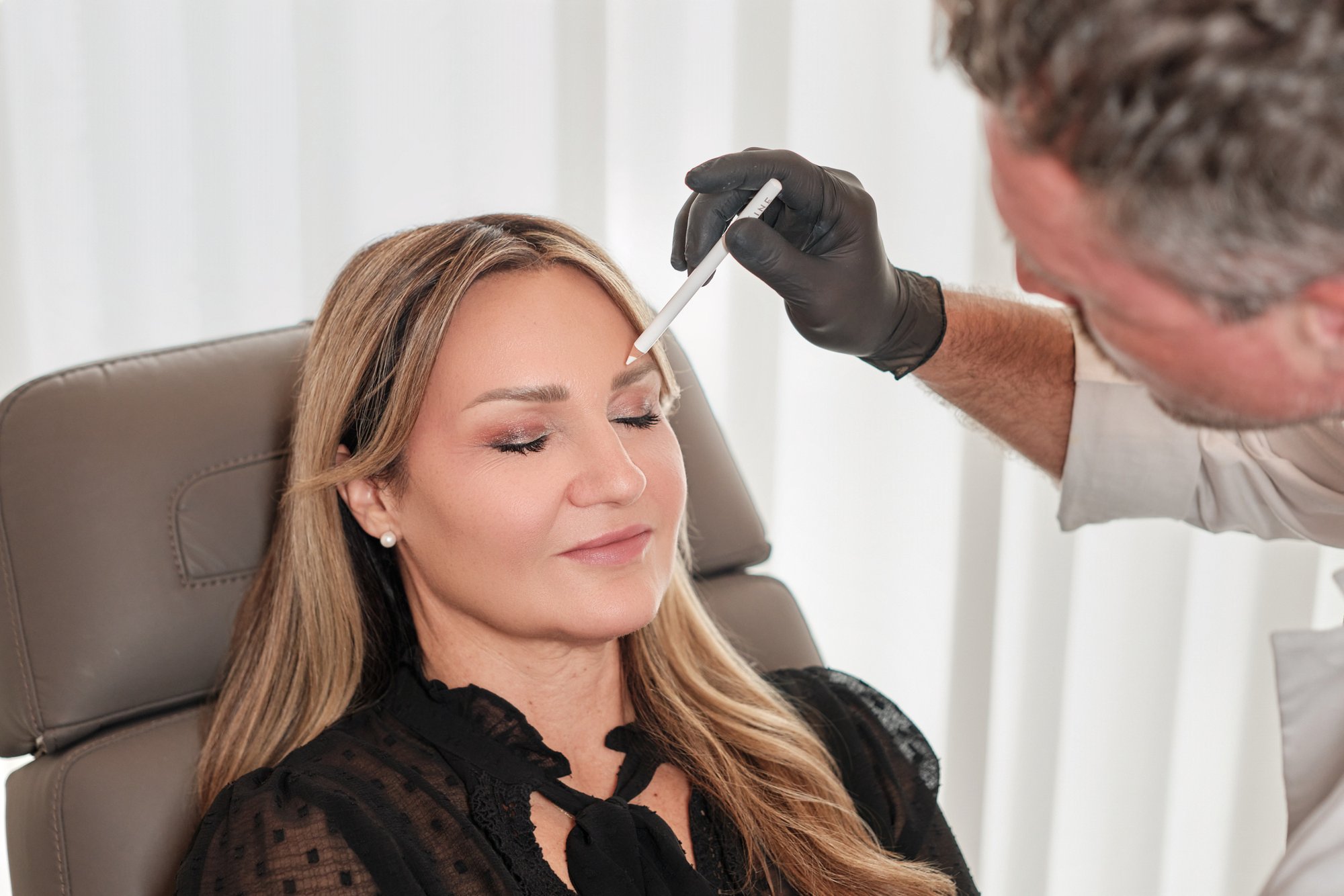
“We don’t simply treat wrinkles. We look at where excessive muscle activity and tension actually develop in the face and release it right there: as much as necessary, as little as possible. Afterwards, a face should look calmer, not stiller.”
Tillmann Lochte, Specialist in Orthopedics and Trauma Surgery / Aesthetic Medicine
Why our face stores tension
Muscles that never fully let go. Around 20 facial muscles shape our expression. Unlike the muscles of the arm or leg, most of them don’t attach to bone but directly to the skin. Every contraction pulls the skin along with it. When you concentrate, you draw your brows together. When you read with effort, you raise your forehead. When you are under pressure, you clench your teeth at night. Individually, this is harmless. Over years, it creates a baseline: the muscle stays slightly active even at rest, and the skin above it always folds in the same spot. A movement becomes an expression, and the expression becomes a line that remains even when we have long since relaxed. That is exactly what we mean when we say: the face stores tension.
Frown lines. Between the brows, two small muscles are at work, the paired corrugator and the procerus. They pull the brows inward and downward, creating the vertical lines above the bridge of the nose. These muscles kick in with concentration, bright light and tension, usually without us noticing. If you use them frequently over years, at some point you look stern, skeptical or annoyed even at rest. Many patients come to us for exactly this reason: not because of the wrinkle, but because of the impression it leaves.
The forehead. The frontalis is the only muscle that raises the brows. It creates the horizontal forehead lines, and it has a second job: it holds the brows up when the depressor muscles work against them or the upper eyelid becomes heavier. That is why “just smoothing everything out with injections” is precisely not the goal. Anyone who immobilizes the forehead generously without considering the interplay of forces risks a heavy, low-set brow and a tired look. At our clinic, the forehead is always planned in relation to its opposing muscles.
The jaw. The masseter is one of the strongest muscles in the body. It closes the jaw, and it is the muscle where stress most often settles: through clenching during the day and grinding during sleep. A permanently tense masseter feels hard, can ache in the morning and grows over time, making the lower face look wider and more angular. For many people, this is the zone where they physically feel tension for the first time.
The neck. The platysma is a thin, flat muscle that runs from the chest over the neck into the lower face, where it blends into the skin. It works downward: it pulls the corners of the mouth and the jawline down and forms the vertical bands on the neck when tensed. A constantly active platysma makes the contour look softer and blurs the transition from chin to neck. You can see this for yourself: clench your teeth lightly and pull the corners of your mouth down. The bands that stand out are this muscle.
Why we look at the whole picture. These four zones don’t work separately. The frown muscles pull downward, the forehead pushes back. The jaw clenches, the neck pulls the lower face along with it. Treating only one area often shifts the balance instead of restoring it. That is why, at Perfect Skin MED, everything starts with a medical tension analysis of the entire face, at rest and in motion. Only then do we decide which muscles to relax and which deliberately not.
- We treat the cause, the muscle, not the line it leaves behind
- Four zones, one plan: frown lines, forehead, jaw and neck are considered in how they interact
- The goal is balance, not stillness: a calm expression while the face keeps moving
Vertical lines between the brows that make you look sterner or more skeptical than you are.
Horizontal lines that form when the brows are raised and become etched in over the years.
A hard, tense jaw that aches in the morning and over time makes the lower face look wider.
Vertical bands that stand out under tension and soften the chin-neck contour.
When your face looks tired, stern or stressed even though you don’t feel that way.
For anyone who wants to start early and conservatively so that dynamic lines don’t become permanent wrinkles.
Vorteile

What does it mean that the face stores tension?
Facial muscles attach directly to the skin. If a muscle is tensed again and again over years, for example when concentrating or clenching your teeth, it remains slightly active even at rest, and the skin above it folds in the same spot. The expression that actually belonged to a particular situation becomes a permanent state. You look stern or strained without being so.
Is this a wrinkle treatment?
Yes, but with a different perspective. We don’t smooth out lines; instead, we specifically relax the muscles that create them. That is why every treatment includes an analysis of the entire face: Which zone pulls, which pushes back, and what happens when one of them comes to rest. The result is a calmer expression, not a smooth face.
Will I look frozen afterwards?
That is the most common concern, and it is justified when treatment is done without a plan. A rigid face results when the forehead is immobilized without taking the depressor muscles into account, or when too much is treated at once. We deliberately start conservatively, plan the interplay of forces as a whole and fine-tune after two weeks. You should be able to look stern when you want to look stern. Just not constantly look sterner than you are.
I clench my teeth at night. Can the treatment help with that?
A permanently tense masseter can be relaxed in a targeted way; as a result, the force of clenching usually decreases and the jaw feels looser. Over a few weeks, the muscle can also become smaller, making the lower face look slimmer. Whether the treatment makes sense for you is something we clarify in a consultation. A night guard from your dentist protects your teeth and is not affected by this. The two can complement each other.
What are the bands on my neck?
The vertical bands that stand out especially when you speak or tense up come from the platysma, the flat neck muscle beneath the skin. They are not a skin problem. When the muscle is relaxed in a targeted way, the bands become less prominent, and the downward pull on the corners of the mouth and the jawline eases. Whether the skin on the neck should also be tightened is something we see in the analysis. Perfect Skin offers dedicated procedures for this.
Is it true that frown lines have something to do with mood?
Interestingly, this is being studied scientifically. The so-called facial feedback mechanism describes how our facial expression not only shows emotions but also influences them in return. Studies are examining whether relaxing the frown muscles can affect mood (reviews: Coles et al. 2019, Emotion Review; Qian et al. 2021, Journal of Psychiatric Research). The data are interesting, but not a promise. Above all, they show how closely facial expression, muscle tension and emotional perception are connected.
How long do the results last, and how often do I need to come in?
The effect is temporary. It sets in after a few days, is fully developed after approx. two weeks and, depending on the muscle, lasts approx. three to six months; in the jaw, experience shows it tends to last longer than on the forehead. Afterwards, muscle function returns completely. Over time, many people need less, because the muscles get used to the reduced activity.
Who is the treatment not suitable for?
Caution is advised during pregnancy and breastfeeding, with certain neuromuscular disorders, with acute infections in the treatment area or with a known intolerance to the products used. In a personal consultation with a physician, we check whether the treatment is the right choice for you.
WHO IS THE TREATMENT SUITABLE FOR?
- People who are in the spotlight at work and want to look more alert and calmer without visibly having had treatment
- Anyone bothered by frown lines, forehead lines or a stern, strained expression
- Those who feel constant tension in their jaw, clench or grind at night and notice an angular-looking lower face
- Those who see bands on their neck or feel that their contour is being pulled downward
- Younger people who want to start early and conservatively, before dynamic lines become etched in
In a personal consultation, we will find out together where your face stores tension and whether this treatment is the right one for you.
RECOVERY & DOWNTIME: QUICK FACTS
- Hours 0 to 4: Slight redness or small bumps at the injection sites are possible and usually subside quickly. Stay upright, don’t massage the areas, no intense exercise, no sauna.
- Days 1 to 2: Everything looks normal, and you can fully go about your routine. It is normal that no effect is visible yet.
- Days 3 to 7: The effect sets in. Your expression becomes noticeably calmer, and your jaw feels looser.
- Week 2: The result is fully developed; time for the follow-up check. In the jaw, a slimmer contour usually only appears after four to eight weeks, because the muscle shrinks slowly.
What stress does to the face
Stress has a place in the face, and usually there are four. Between the brows, two small muscles contract during concentration and tension. On the forehead, a flat muscle holds the brows up as soon as the upper eyelid becomes heavier or the depressor muscles work against it. In the jaw, the masseter clenches, often at night and unnoticed. On the neck, the platysma pulls the lower face downward. None of these movements is a problem in itself. The problem is repetition: a muscle that kicks in every day for years eventually no longer fully lets go, even at rest. The skin above it always folds in the same spot, and a moment becomes an expression. That is why many people look stern, tired or stressed even when they aren’t at that moment.
Why relaxing doesn’t mean smoothing
Good treatment of these zones doesn’t start with the wrinkle, but with the question of which muscle creates it and which other muscles depend on it. The upper face is an interplay of forces between depressor muscles and a single elevator. Immobilizing the forehead without taking the frown lines into account results in a heavy brow. Releasing the frown lines without considering the forehead risks a brow that is pulled up at the sides, giving a surprised look. And relaxing the jaw also changes how the lower face and neck work together. That is why relaxing never means smoothing at Perfect Skin MED. It means adjusting the balance of the muscles so that the expression becomes calmer and the face keeps moving. The benchmark is not smooth skin, but whether you recognize yourself in the mirror, just more rested.
Jaw and neck: the two zones that are usually overlooked
When it comes to wrinkle treatments, most people think of the forehead and eyes. Yet tension sits particularly often in the jaw and on the neck. A permanently tense masseter grows over time, the lower face looks wider and more angular, and the jaw aches in the morning. When the muscle is relaxed in a targeted way, the force of clenching usually decreases, and over a few weeks the muscle can become smaller. The platysma, in turn, pulls the corners of the mouth and the jawline downward and forms the vertical bands on the neck. Relaxing it takes the pull out of the lower face, and the contour looks more defined. For us, both are part of the tension analysis, because a face doesn’t end at the jawline.
Regenerating: what comes after relaxation
Once the tension is released, the skin shows what it needs on its own. That is why, at Perfect Skin MED, relaxing is often followed by regenerating: skin boosters or polynucleotides for hydration and firmness, biostimulators for structure, and, if needed, tightening from within at the transition from chin to neck with ThermaDAS Endolifting. This principle, regenerative before corrective, runs through all of Tillmann Lochte’s treatments: first strengthen the tissue, then modulate in a targeted way, and use fillers only where structure is missing. Learn more on the page Double Chin & Contour with ThermaDAS Endolifting and on the page of Tillmann Lochte.
Stress & Balance in Berlin Mitte
Perfect Skin MED treats patients at Reinhardtstraße 15 in Berlin Mitte, just a few minutes’ walk from Friedrichstraße station and Berlin Central Station. Tillmann Lochte is responsible for the medical treatments. Our team advises you in seven languages, and more than 2,600 reviews with an average rating of 4.9 stars show how our patients experience our care. Book your tension analysis. We will show you honestly where it’s worth letting go.

Make an appointment with us now!
We will be happy to take enough time for you, advise you and find the right treatment plan for you together. We look forward to hearing from you! We speak German, English, Polish, Arabic, Russian, Romanian and Vietnamese.
To contactKnowledge, Update and Offers
Don’t miss:
Subscribe to our Perfect Skin News here!

News and offers

New
Aesthetic medicine with us

20%
on cryolipolysis
